
Why Caribbean Online Shoppers Can't Find Your Store (and How to Fix It)

A customer searches for a product you stock. They find a marketplace, a social post from a competitor, or a store that cannot deliver to their island. Your shop never enters the comparison.
That problem is not always about having the wrong product or price. It can come down to whether search engines and AI assistants can understand what you sell, where you deliver, and why a customer should trust you.
In 2026, online shoppers may move between Google, social media, marketplaces and AI tools such as ChatGPT, Perplexity and Copilot before deciding. The practical task is to make your store visible and credible across those moments, without assuming one channel will do everything.
By Phoenix Caribbean··8 min read
Start with the gap between search and purchase
A 2026 Tower Consumer Survey reported that 95% of Cayman Islands respondents use Google or another search engine to find local businesses. The same survey found that 16% had purchased products or services online from local businesses. Those findings apply to the survey's Cayman respondents, not the whole Caribbean, but they highlight an important distinction: being searched for does not automatically mean being chosen.
The journey may look like this: someone sees a product on social media, checks whether the business is legitimate, searches for alternatives, then tries to confirm price, delivery and payment details. If any of those answers are missing, or contradict one another, the shopper may leave.
For retailers developing an online marketing Caribbean strategy, that means looking beyond traffic totals. First ask: can customers find the right product, understand whether it suits them, and confirm that buying it on their island is practical?
What we see in the discovery journey
In our work with Caribbean businesses, the useful first question is often not "How do we get more clicks?" It is "Where does the customer become uncertain?" A retailer may already have visits, but product descriptions are too thin to match specific searches. Or the store is visible, but shipping information is hard to find.
These issues are especially relevant across islands. A shopper in Barbados may want to know about delivery to Barbados; a shopper in the BVI may need different information about stock, timing, payment or collection. "We deliver regionally" does not answer those questions clearly.
If you arrived here searching for ecommerce web design Caribbean, this article focuses on discovery and trust, not choosing a platform or planning a store build. Those are separate decisions.
How customers find and assess online stores
A business does not need to dominate every channel. The right mix depends on your margins, stock, audience, delivery area and capacity to fulfil orders. Social may be a strong first touchpoint; a clear product page and delivery policy can help the shopper make the next decision.
- Google Search
- What it can do
- Connect a product or business with people actively looking for it
- Best suited to
- Product searches, brand searches and local intent
- Trade-off
- Visibility depends on relevance, indexability and competition; rich results are not guaranteed
- AI assistants
- What it can do
- Summarise and compare information from sources they can access
- Best suited to
- Questions with several requirements, such as product type, budget and delivery location
- Trade-off
- Each assistant works differently; inclusion and accuracy are not guaranteed
- Social media
- What it can do
- Put products in front of people through visual content, sharing and recommendations
- Best suited to
- Discovery, new collections and community engagement
- Trade-off
- Interest does not always translate into detailed product research or a completed purchase
- Marketplaces
- What it can do
- Give shoppers a familiar place to browse and compare products
- Best suited to
- Reaching customers who already use that marketplace
- Trade-off
- Fees, competition and platform rules can limit control over the customer relationship
A product page should explain more than its name and price. Include the information a customer needs to decide, in plain text that search engines and assistants can access:
Make product pages useful to people and machines
- What the product is, what it does and who it is for.
- Materials, dimensions, fit, compatibility or care instructions where relevant.
- Current price and currency, availability and product variations.
- Which islands you serve, with realistic delivery options and timing.
- Payment methods, returns, warranty and a clear way to ask a question.
Descriptions copied from a supplier often omit the differences that matter to local buyers. Add accurate details in your own words. If a particular item is suitable for a specific use, say why. If delivery is limited, state that plainly rather than leaving shoppers to find out at checkout.
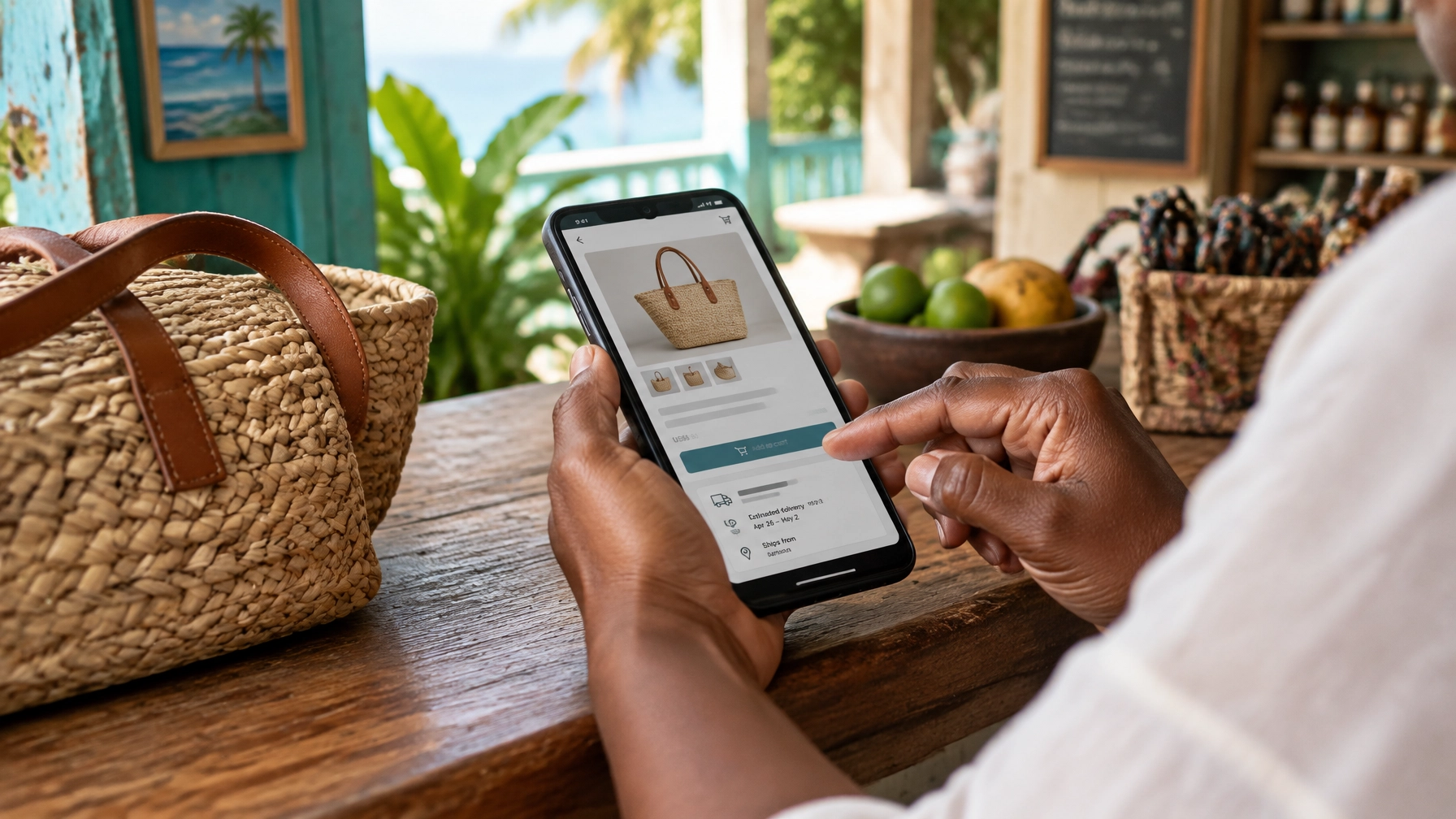
Use product data, but do not treat schema as a shortcut
Structured data, often called schema markup, is information added to a page in a format that search engines can interpret. For a store that sells products directly, accurate Product and Offer data can describe details such as the product name, price and availability.
Google distinguishes between merchant listings for pages where a customer can buy a product, and product snippets for pages that do not offer direct purchase. Google also recommends pairing on-page product data with a Merchant Center feed where appropriate. This can make product information easier to verify, but does not guarantee a special search appearance.
Keep the markup consistent with what a shopper can see. If stock, price, delivery or return information changes on the page, the related data should not keep showing the old version. Read Google's guidance on Product structured data.
There is no special Google schema that guarantees placement in AI Overviews or AI Mode. Google says pages must meet its standard Search requirements and follow the usual SEO fundamentals. Other AI assistants may use different sources, indexes or product data. Clear, current facts give them more to work with, but no approach guarantees a citation or recommendation.
For a broader introduction, see our guide to Generative Engine Optimisation for Caribbean businesses.
Treat each island as a real market
If you genuinely deliver to several islands, make the details easy to find for each market you serve. A useful location or delivery page should explain the products available, delivery options, timing, costs or restrictions, and relevant payment details.
Avoid creating many near-identical pages that change only the island name. They give shoppers little useful information and can make your site harder to trust. Build a page when you have something specific to say about that market.
If your business is eligible for a Google Business Profile, keep its details accurate and consistent. Do not create profiles for places where you do not have a genuine eligible presence. For online-only businesses, make the business identity, contact route and delivery coverage clear on your website and other legitimate listings.
Speed and trust help shoppers choose
Many Caribbean customers browse on mobile connections that vary by island, provider and location. A slow product page can delay both discovery and a buying decision. Large images, unnecessary scripts and content that only appears after complex interactions can make important details harder to reach.
Test key product pages on a phone and a mobile connection, not just on office Wi-Fi. Our guide to website speed on Caribbean mobile networks explains the regional considerations in more detail.
Trust is equally practical. Show genuine reviews, clear contact information, accurate stock, and straightforward delivery and returns policies. Ask customers for honest feedback and respond constructively. Do not invent reviews or mark up ratings that are not visible on the page.

A prioritised checklist for search and AI citability
Work through these steps in order. Start with the information that most directly affects whether a shopper can find and choose a product.
- Check what Google can see. Confirm key product pages are indexed, crawlable and linked from relevant pages on your site. Google's AI features guidance says the usual Search eligibility and SEO fundamentals apply.
- Improve your most important product pages. Add specific descriptions, useful attributes, visible price and stock, and clear delivery and returns information.
- Make island coverage explicit. State where you deliver and what varies by location. Create distinct market information only where it genuinely helps customers.
- Add accurate product structured data. Use the markup relevant to products that can be purchased, and make sure it matches the visible page.
- Review your product feeds and listings. Where you use Merchant Center or marketplaces, check that product names, prices, availability and delivery details agree with your website.
- Strengthen trust evidence. Gather genuine, recent reviews and make it easy to find business contact details and policies.
- Test the mobile buying journey. Search for a product on a phone, open the page, check island delivery information and follow the route toward purchase. Fix points where the shopper has to guess.
Advantages and trade-offs
Improving discovery across search and AI can help customers find products through more than one route. It can also make product information clearer for people who have already landed on your site.
The trade-off is that this work requires accurate information and coordination. Product pages, feeds, stock details and island delivery policies need to agree. SEO takes time, and algorithm changes or platform rules can affect visibility. Paid campaigns or marketplaces may bring attention sooner, but involve spend, fees or less control. Choose based on your commercial priorities, not the promise of a single channel.
Make the next step clear
Caribbean online shoppers discover stores through a mix of search, social media, marketplaces and AI tools. The strongest starting point is not to chase every channel. It is to make your product information accurate, useful, locally relevant and easy to verify.
If you are unsure where shoppers are getting stuck, we can help assess the discovery journey and recommend practical priorities. Read about our SEO and GEO services, or get in touch for a straightforward conversation.
Last updated by the Phoenix Caribbean team, Road Town, Tortola, British Virgin Islands.
Frequently asked questions.
Related guides.
Generative Engine Optimisation (GEO): how Caribbean businesses get cited by AI
What Generative Engine Optimisation is, how it differs from SEO, and the practical steps Caribbean businesses can take to be cited by ChatGPT, Copilot, Gemini and Perplexity.
Building fast websites for Caribbean mobile networks
Why website speed matters disproportionately in the Caribbean, what to measure, and the practical techniques that make regional sites load fast on mobile networks.
Ecommerce Web Design in the Caribbean: Selling Online Across Islands Without Overbuilding
A practical guide to ecommerce web design for Caribbean businesses, covering payments, currencies, cross-island shipping, mobile-first design, platform options, costs, timelines and when a catalogue-plus-enquiry website is the better starting point.
Want a clear view of why shoppers aren't finding your store?
Book a free 30-minute consultation and we will review your store's discovery journey across search, social and AI, then suggest practical priorities.
Book a free consultation